Welcome to Our Company -

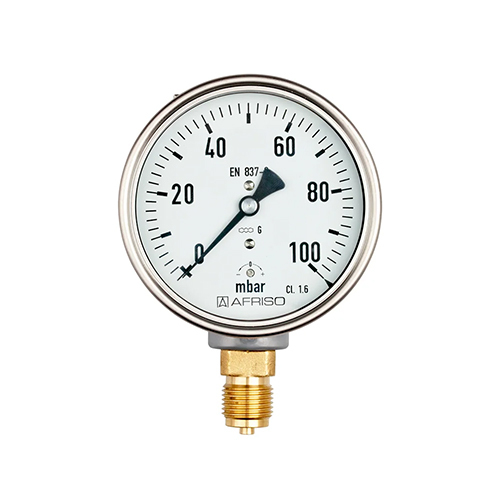
Product Details:
- Seal Material Buna-N / Neoprene
- Sensor Type Capsule Element
- Grade Industrial
- Thread 1/2 BSP
- Bourdon Tube Not Applicable (Capsule Type)
- Display Analog Dial
- Outer Size 110 mm
X
Standard Capsule Pressure Gauges Type D4 Product Specifications
- Capsule Element
- Aluminum, black finish
- 100 mm
- Industrial
- 1/2 BSP
- Buna-N / Neoprene
- Matt / Glossy
- ±1.6% F.S.
- Aluminum with printed scale
- 0 to 600 mmWC
- Low Pressure (Gas / Air)
- Mounting Bracket, Calibration Certificate
- 110 mm
- Analog Dial
- Bottom / Back
- Machined
- Stainless Steel (SS 304/316)
- 100 mm
- Not Applicable (Capsule Type)
- -20°C to +70°C
- Brass / SS
- Non-corrosive Gases
- Clear Glass / Shatterproof Glass
- IP52 / IP65 (Optional)
- Bottom / Center Back
- Stainless Steel / Mild Steel
- 1 Piece
- Panel / Surface / Direct
Product Description
TypeD4
Nominal size100
Accuracy class (EN 837-3/6)1,6
Ranges (EN 837-3/5)See ordering table
Application area
Static load:Full scale value
Dynamic load:0.9 x full scale value
Overload safety:1.3 x full scale value
Operating temperature range
Medium:Max. 60 °C
Ambient:-20/+60 °C
Temperature performanceIndication error when the temperature of the measuring system deviates from the normal temperature of 20 °C:
at rising temperature approx. ± 0.6 %/10 K
falling temperature approx. ± 0.6 %/10 K
of full scale value
at rising temperature approx. ± 0.6 %/10 K
falling temperature approx. ± 0.6 %/10 K
of full scale value
Degree of protection
NG 100:IP 54 (EN 60529)
Standard design
ConnectionBrass, bottom
Measuring elementCapsule element, CuBe alloy
MovementBrass
Zero correctionFrom the front
SealNBR (Perbunan)
DialAluminium, white
Scaling black
Scaling black
PointerAluminium, black
HousingStainless steel 304
Bayonet type bezelStainless steel 304
Window
D401:Instrument glass
Options
- Overpressure and underpressure safety 10 x FSD
- Back flange
- Panel mounting bezel, with window, plastic
- 3-hole fixing, panel mounting bezel with window, plastic
- Damping screw
- Reference pointer
- Special scales
- Other process connections
Durable Construction with Flexible Configurations
The Type D4 capsule pressure gauges are engineered using high-quality stainless steel (SS 304/316) or mild steel, with options for both matt and glossy finishes. They accommodate a range of mounting styles-panel, surface, or direct-and can be fitted with either clear or shatterproof glass for added protection.
Precision Measurement for Low-Pressure Gases
Designed primarily for measuring low-pressure non-corrosive gases or air, these gauges operate efficiently within a scale range of 0 to 600 mmWC. Their capsule element sensor provides reliable and repeatable analog dial readings with a commendable accuracy of 1.6% F.S. under ambient temperatures from -20C to +70C.
Comprehensive Accessories and Certification
Each gauge is supplied with a mounting bracket and a calibration certificate, ensuring straightforward installation and verified measurement accuracy. With a minimum order quantity of just one piece, this solution is accessible for both small and large-scale industrial requirements.
FAQ's of Standard Capsule Pressure Gauges Type D4:
Q: How do I choose between the stainless steel and mild steel case material for the D4 capsule pressure gauge?
A: The choice depends on your application's environment. Stainless steel cases are highly resistant to corrosion, making them suitable for humid or challenging conditions, while mild steel is ideal for general indoor use where high corrosion resistance is not required.Q: What types of gases can the D4 capsule pressure gauge safely measure?
A: This gauge is designed for non-corrosive gases and air. It should not be used with aggressive or corrosive gases that could affect the capsule or internal components.Q: When is it beneficial to select shatterproof glass instead of clear glass for the window?
A: Shatterproof glass is recommended in environments where physical impacts, vibration, or potential glass breakage could occur, providing additional safety and durability over standard clear glass.Q: Where should the pressure gauge be installed: bottom or center back connection?
A: The installation location depends on your panel or system layout. Bottom connections are suitable for direct or surface mounting, whereas center back connections are optimal for panel mounted applications, facilitating clear visibility and easy access.Q: What process is followed for calibration of the Standard Capsule Pressure Gauge Type D4?
A: Each gauge undergoes precise calibration against reference standards, ensuring reliable accuracy. A calibration certificate accompanies every gauge, validating its performance within 1.6% F.S. accuracy.Q: How is the protection class (IP52/IP65) relevant to my operating environment?
A: Protection class IP52 offers basic protection against dust and dripping water, suitable for most indoor settings. IP65 upgrades provide robust protection against dust and water jets, making the gauge ideal for more demanding or moist environments.Q: What benefits does the capsule element sensor offer over a Bourdon tube for low-pressure measurement?
A: The capsule element is highly sensitive to low pressures, making it more accurate and reliable for low-pressure gas or air applications, whereas Bourdon tubes are better suited for higher pressure ranges.Tell us about your requirement

Price:
Quantity
Select Unit
- 50
- 100
- 200
- 250
- 500
- 1000+
Additional detail
Mobile number
Email

Other Products in 'Pressure Gauges' category



Contact Details

- Shop No: 303-304, Block - C, 3rd Floor, Pushp Business Campus, S P Ring Road, Vastral, Ahmedabad - 382418, Gujarat, India
- Phone : 08045478447
GST : 24AAJCP7915M1ZX

- Mr Ramnarayan Ajmera (Manager-Business Development)
- Mobile : 08045478447
- Send Inquiry
 Send Inquiry
Our Products
- Portable Temperature Datalogger
- Air Flow And Velocity Transmitter
- Vibration Sensors
- Differential Pressure Transmitter
- Wireless Sensors & Transmitters
- Digital Manometer
- Low Pressure Generator & Calibrators
- Chart Recorder
- Pressure Gauge
- Temperature & Humidity Transmitter
- Carbon Dioxide Transmitter
- VOC Transmitter
- Infrared Temperature Sensors And Pyrometers
- Pressure Transmitter
- RTD Temperature Probes
- Temperature Transmitters
- Differential Presure Switch
- Indicator Controller Transmitters
- Level Transmitter Solid & Liquid
- Milk Silo Level Transmitters
- Point Level Switch - Solid & Liquid
- Pressure Switch
- Flow measuring Devices (Pitot Tube)
- Ozone Analyzer
- Inline Optical Brix Transmitter
- PH-ORP Electrode
- pH Probe housings & accessories
- Probe Housing
- Turbidity Sensor
- Temperature And Humidity Transmitter
- Infrared Temperature Sensors
- Process PID Controller
- Profile Controllers
- Control Unit Of Pneumatic Retractable Ph Housings
- Smart Positiong Drive
- Thyristor Power Controller
- Digital Temperature Switch
- Handheld Digital Probe Thermometer
- Differential Pressure Gauge
- Digital Differential Pressure Gauge
- Gas Pressure Switch
- Vacuum Pressure Switches
- Boot Level Switch
- Hydrostatic Level Transmitter
- Pendulum Level Switch
- Clean Room Differential Pressure Indicator
- Differential Pressure & Flow Controller
- Pressure Gauges
- Digital Electronic Pressure Switch
- Draft Pressure Transmitter
- Chute Jam Level Switch
- Overflow Switch for Screw-Chain Conveyor
- Air Flow Switch
- Averaging Flow Sensor
- Plug-in Type
- Terminal Block Type
- Flow Indicators & Totalizer
- Portable Air Velocity meter
- Stack Air Velocity Transmitter
- Broken Bag Leak Detector
- Carbon Dioxide Transmitters
- Conductivity Transmitters
- Dissolved Oxygen Analyzer
- Duct smoke detector
- Filter monitoring
- Inline Process Refractometer
- Inline Total Solid (TS) Transmitter
- Optical Density Transmitter (Biomass)
- Immersion fittings
- Retractable housings - manual
- Retractable housings - pneumatic
- Static probe housings
- pH Transmitter & Controller
- Solid Flow Monitor
- Stack Dust Monitor (QAL 1 Certified)
- Indoor Air Quality Transmitter
- Particulate Matter Transmitter
- Digital Process Indicator
- Loadcell Indicator
- Hiperdrive Positioning Systems
- Positioning Systems 3 Series
- Other Positioning Systems
- ATEX Boot Level Switch
- ATEX Broken Bag Leak Detector
- ATEX Flameproof Air Differential Pressure Switch
- ATEX IR Temperature Sensors
- ATEX Membrane Level Switch
- ATEX Pendulum Level Switch
- ATEX Pressure Switch 901P EX
- ATEX vibration sensor
- Flameproof Level Switches & Transmitters
- Flameproof Pressure Transmitter
- Building Controllers
- Digital Portable Manometer
- ORP Transmitters
- Free Chlorine Analyzer
- Total Chlorine Analyzer
- Chlorine Dioxide Analyzer
- Integrated BLDC Motor
- ATEX Differential Pressure Switch 930 EX
- CO2 Transmitter
 Send Inquiry
 Send SMS
 Call Me Free
PARSHVI TECHNOLOGY (INDIA) PRIVATE LIMITED
All Rights Reserved.(Terms of Use)
Developed and Managed by Infocom Network Private Limited.
Developed and Managed by Infocom Network Private Limited.
