Welcome to Our Company -

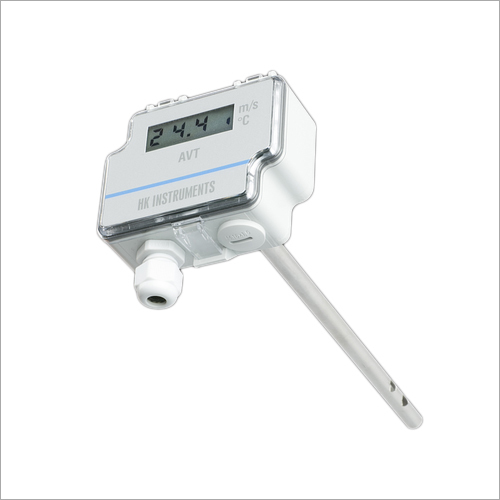
Product Details:
- Connectivity Type 4-20mA/0-10V analog output
- Application Media Air, Non-corrosive Gases
- Flow Rate Display in m/s or selectable format
- Protection IP65
- Diameter Probe diameter 8 mm
- Current Range 4-20mA
- Equipment Type Transmitter
X
Air Velocity Transmitter Product Specifications
- 0 - 30 m/s
- ABS Housing
- Display in m/s or selectable format
- -10C to +60C
- 4-20mA
- 4-20mA/0-10V analog output
- 3% of reading
- Air, Non-corrosive Gases
- 0 to 30 m/s
- Transmitter
- LCD Digital Display
- 0.1 m/s
- Hot-wire anemometer
- Max 2 VA
- Industrial Continuous Operation
- 0 30 m/s
- Probe diameter 8 mm
- IP65
- 24V DC 10%
- 0 to 95% RH (non-condensing)
- Indoor, controlled climate
- Screw terminal (removable)
- m/s or ft/min (selectable)
- Via front-accessible potentiometer
- Approx. 150 g
- Selectable 4-20mA/0-10V
- Duct or wall mounting
- <2 seconds
- CE Marked
Product Description
The AVT is an electronic air velocity and temperature transmitter for air and non-combustible gases with optional relay output.
AVT air velocity transmitters are engineered for building automaton in the HVAC/R industry. They are electronic air velocity and temperature transmitters for air. They measure air velocity and temperature in ventilation ducts, with field selectable options for measurement range and output settings in a single device.
AVT has a duct mount probe and an adjustable duct flange suitable for round or rectangular ducts.
AVT series devices include:
- Separate readings and outputs for air velocity and temperature
- Proportional output options: voltage (010 V) and current (420 mA)
- PID controller for air velocity (-D models)
- Three field selectable measurement ranges for air velocity, selectable with jumpers (models without display)
- Freely selectable measurement range for air velocity via menu (-D models)
- Field selectable measurement units (-D models):
air velocity: m/s, ft/min
temperature: Celsius, Fahrenheit -
AVT series device options offer:
- Display (-D models)
- Field adjustable relay (-R models)
- Modbus (-MOD models)
Optional relay output : Will work as Air flow Switch Technical Details :
| Air velocity measurement: | Measurement range: |
| Temperature measurement: | Measurement range: |
| Measuring units: | Air velocity: m/s or ft/min |
| Supply voltage: | 24 VDC 10 % / 24 VAC 10 % |
| Current consumption: | max. 80 mA + 40 mA with mA output + 10 mA with relay option (DC supply voltage) |
| Output signal 1 (T out [C]) : | 010 Vdc, load > 1 k |
| Output signal 2 (v out [m/s]) : | 010 Vdc, load > 1 k |
| Optional relay output: | 250 Vac, 6 A res., adjustable operating direction, switching point and hysteresis |
| Operating temperature: | -2550 C (probe) |
| Probe: | Stainless steel, adjustable immersion length, mounting flange included |
| Protection standard: | IP54, cable downwards |
Precision and Versatility
Engineered for industrial use, this transmitter provides high accuracy (3% of reading) and rapid response for dynamic environments. The selectable output format (4-20mA/0-10V) and dual mounting options (duct or wall) support various installation requirements. Its compact 8 mm sensor probe and lightweight design enhance adaptability.
User-Friendly Features
The transmitter's backlit LCD clearly displays velocity readings in either m/s or ft/min. Adjustment for zero and span is straightforward via a front-mounted potentiometer. Removable screw terminal cable connections simplify installation and maintenance, making this transmitter ideal for seamless integration into building automation or process control.
Reliable and Robust Design
Built for durability, the IP65-rated ABS housing ensures protection against dust and moisture in controlled indoor climates. Operating over a wide temperature and humidity range (-10C to +60C, 0 to 95% RH non-condensing), the device is suited for demanding continuous industrial monitoring of air and non-corrosive gas flows.
FAQ's of Air Velocity Transmitter:
Q: How do I install the air velocity transmitter in a duct or on a wall?
A: The transmitter can be mounted directly onto a duct or a flat wall using suitable hardware. Ensure that the sensor probe is properly positioned in the airstream for accurate measurement and that all connections through the removable screw terminal are secure before powering on.Q: What output signals are supported by the transmitter, and how do I select between them?
A: This unit offers selectable analog outputs, either 4-20mA or 0-10V, which can be chosen during setup according to your system requirements. Refer to the wiring diagram and use the selection switch or jumper inside the housing to configure your preferred signal type.Q: When should I perform zero or span adjustment, and how is it done?
A: Zero and span adjustments are recommended after initial installation or whenever calibration checks indicate a drift. Both can be performed easily using the potentiometers accessible on the front panel, following the instructions in the user manual.Q: Where can I use this transmitter, and what media is it suitable for?
A: It is designed for use in indoor, controlled climate environments and measures the velocity of air or non-corrosive gases. The protection class (IP65) and robust construction make it suitable for a range of industrial applications such as HVAC, cleanrooms, and process control.Q: What is the benefit of the selectable display units and output types?
A: Selectable display units (m/s or ft/min) improve operational flexibility for local or international users, and the choice of output signal (4-20mA or 0-10V) allows easy integration into various monitoring and control systems.Q: How does the transmitter handle variable environmental conditions during operation?
A: With an operating range of -10C to +60C and tolerance for up to 95% RH (non-condensing), the device reliably functions in diverse indoor industrial settings without performance loss, provided the environment is controlled and free from corrosive substances.Q: What are the main advantages of using a hot-wire anemometer for air velocity measurement?
A: The hot-wire anemometer principle offers fast (<2 sec) and accurate velocity readings (3% of reading) with high resolution (0.1 m/s), making it ideal for real-time monitoring and control tasks in industrial applications demanding precision.Tell us about your requirement

Price:
Quantity
Select Unit
- 50
- 100
- 200
- 250
- 500
- 1000+
Additional detail
Mobile number
Email

Other Products in 'Air Flow And Velocity Transmitter' category




Contact Details

- Shop No: 303-304, Block - C, 3rd Floor, Pushp Business Campus, S P Ring Road, Vastral, Ahmedabad - 382418, Gujarat, India
- Phone : 08045478447
GST : 24AAJCP7915M1ZX

- Mr Ramnarayan Ajmera (Manager-Business Development)
- Mobile : 08045478447
- Send Inquiry
 Send Inquiry
Our Products
- Portable Temperature Datalogger
- Air Flow And Velocity Transmitter
- Vibration Sensors
- Differential Pressure Transmitter
- Wireless Sensors & Transmitters
- Digital Manometer
- Low Pressure Generator & Calibrators
- Chart Recorder
- Pressure Gauge
- Temperature & Humidity Transmitter
- Carbon Dioxide Transmitter
- VOC Transmitter
- Infrared Temperature Sensors And Pyrometers
- Pressure Transmitter
- RTD Temperature Probes
- Temperature Transmitters
- Differential Presure Switch
- Indicator Controller Transmitters
- Level Transmitter Solid & Liquid
- Milk Silo Level Transmitters
- Point Level Switch - Solid & Liquid
- Pressure Switch
- Flow measuring Devices (Pitot Tube)
- Ozone Analyzer
- Inline Optical Brix Transmitter
- PH-ORP Electrode
- pH Probe housings & accessories
- Probe Housing
- Turbidity Sensor
- Temperature And Humidity Transmitter
- Infrared Temperature Sensors
- Process PID Controller
- Profile Controllers
- Control Unit Of Pneumatic Retractable Ph Housings
- Smart Positiong Drive
- Thyristor Power Controller
- Digital Temperature Switch
- Handheld Digital Probe Thermometer
- Differential Pressure Gauge
- Digital Differential Pressure Gauge
- Gas Pressure Switch
- Vacuum Pressure Switches
- Boot Level Switch
- Hydrostatic Level Transmitter
- Pendulum Level Switch
- Clean Room Differential Pressure Indicator
- Differential Pressure & Flow Controller
- Pressure Gauges
- Digital Electronic Pressure Switch
- Draft Pressure Transmitter
- Chute Jam Level Switch
- Overflow Switch for Screw-Chain Conveyor
- Air Flow Switch
- Averaging Flow Sensor
- Plug-in Type
- Terminal Block Type
- Flow Indicators & Totalizer
- Portable Air Velocity meter
- Stack Air Velocity Transmitter
- Broken Bag Leak Detector
- Carbon Dioxide Transmitters
- Conductivity Transmitters
- Dissolved Oxygen Analyzer
- Duct smoke detector
- Filter monitoring
- Inline Process Refractometer
- Inline Total Solid (TS) Transmitter
- Optical Density Transmitter (Biomass)
- Immersion fittings
- Retractable housings - manual
- Retractable housings - pneumatic
- Static probe housings
- pH Transmitter & Controller
- Solid Flow Monitor
- Stack Dust Monitor (QAL 1 Certified)
- Indoor Air Quality Transmitter
- Particulate Matter Transmitter
- Digital Process Indicator
- Loadcell Indicator
- Hiperdrive Positioning Systems
- Positioning Systems 3 Series
- Other Positioning Systems
- ATEX Boot Level Switch
- ATEX Broken Bag Leak Detector
- ATEX Flameproof Air Differential Pressure Switch
- ATEX IR Temperature Sensors
- ATEX Membrane Level Switch
- ATEX Pendulum Level Switch
- ATEX Pressure Switch 901P EX
- ATEX vibration sensor
- Flameproof Level Switches & Transmitters
- Flameproof Pressure Transmitter
- Building Controllers
- Digital Portable Manometer
- ORP Transmitters
- Free Chlorine Analyzer
- Total Chlorine Analyzer
- Chlorine Dioxide Analyzer
- Integrated BLDC Motor
- ATEX Differential Pressure Switch 930 EX
- CO2 Transmitter
 Send Inquiry
 Send SMS
 Call Me Free
PARSHVI TECHNOLOGY (INDIA) PRIVATE LIMITED
All Rights Reserved.(Terms of Use)
Developed and Managed by Infocom Network Private Limited.
Developed and Managed by Infocom Network Private Limited.
