Welcome to Our Company -

Product Details:
- Display Analog Dial
- Thread 1/2 BSP (Standard)
- Bourdon Tube Stainless Steel Bourdon Tube
- Outer Size 100 mm
- Grade Industrial Grade
- Seal Material Neoprene Rubber Gasket
- Sensor Type Pressure Sensor
X
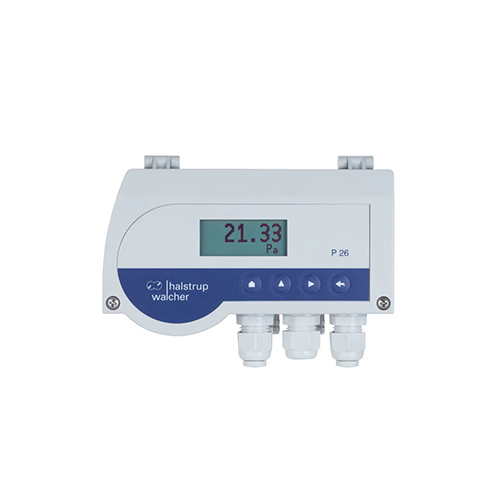
Draft pressure transmitter P 26 Product Specifications
- Polished Finish
- 100 mm
- 0 to 1000 mm WC (Water Column)
- Stainless Steel Bourdon Tube
- 100 mm
- 1/2 BSP (Standard)
- Stainless Steel Body
- Analog Dial
- Pressure Sensor
- Neoprene Rubber Gasket
- Industrial Grade
- Die Cast
- +/- 1% FSD
- Surface / Wall Mounting
- 100 mm
- Aluminum Red Painted
- Wall Mounting Clamp, Instruction Manual
- Air, Gas
- Aluminum with Anti-glare Coating
- Draft Pressure Gauge / Transmitter
- Industrial Draft Measurement in HVAC, Boilers, Cleanrooms
- Not Required (Mechanical)
- Approx. 350 g
- IP54
- Up to 60C
- Instantaneous
- Bottom Connection
Product Description
Measurement ranges
10 / 50 / 100 / 250 / 500 Pa
1 / 2.5 / 5 / 10 / 20 / 50 / 100 kPa
freely scalable from 10 .. 100 % within a measurement range
(others available on request)
Margin of error
0,2 % or 0,5 % of max. value
(0.3 Pa margin of error for the reference)
Output (linear / root-extracted)
0 .. 10 V (RL 2 k)
0 .. 20 mA (RL 500 )
4 .. 20 mA (RL 500 )
5 V (RL 2 k)
(output signals can be configured freely)
Power supply
24 VAC/DC, 10 %
24 VAC, +6 % (with galvanic seperation)
230/115 VAC, -15 %
Interface (optional)
USB, data cable supplied
External zero-point calibration
Display (optional)
multi-coloured LCD and keyboard
Reliable Draft Measurement for Industry
Engineered for industrial grade performance, the P 26 delivers accurate draft pressure readings crucial for HVAC, cleanroom, and boiler applications. Its mechanical construction requires no external power, making it an excellent choice for reliable pressure monitoring even in power-sensitive settings. Its stainless steel body and Bourdon tube enhance durability and resistance to corrosion.
Ease of Installation and Operation
The P 26 features a bottom connection with a standard 1/2 BSP thread and is supplied with a wall mounting clamp for straightforward installation. With surface or wall mounting options and an analog dial for instant pressure readings, setup and ongoing use are convenient for operators and technicians alike.
FAQ's of Draft pressure transmitter P 26:
Q: How does the Draft Pressure Transmitter P 26 measure draft pressure without external power?
A: The P 26 operates mechanically using a stainless steel Bourdon tube and pressure sensor, which respond to changes in draft pressure. Displacement in the Bourdon tube is transferred to the analog dial, offering instantaneous readings without requiring an external power supply.Q: What applications is the P 26 draft pressure gauge suitable for?
A: This transmitter is ideal for industrial environments such as HVAC systems, boilers, cleanrooms, and gas or air draft measurement scenarios where precise, reliable monitoring is essential.Q: When should the P 26 gauge be used over electronic alternatives?
A: The P 26 is best deployed when power-free operation is critical, or in locations where electrical safety and resilience are paramount. Its robust mechanical design ensures consistent performance in harsh or sensitive environments.Q: Where can the P 26 pressure transmitter be installed?
A: Thanks to its wall and surface mounting options, the transmitter is versatile for use in various industrial areas, including plant rooms, HVAC system panels, and cleanroom monitoring points.Q: What is the process for installing the P 26 draft pressure transmitter?
A: Installation involves mounting the device securely using the provided wall clamp, connecting it via the 1/2 BSP bottom thread to your pressure line, and referring to the included instruction manual for optimal setup and calibration.Q: How should the transmitter be maintained to ensure accuracy?
A: Routine visual inspection for cleanliness, checking for mechanical damage, and ensuring the connection threads are secure will optimize accuracy. No electrical maintenance is needed, making upkeep straightforward and cost-effective.Q: What are the primary benefits of using the P 26 pressure gauge in industrial applications?
A: Users benefit from rapid, reliable readings, robust stainless steel construction with polished and anti-glare finishes, and flexible installation options. The mechanical design ensures minimal maintenance and dependable performance under diverse industrial conditions.Tell us about your requirement

Price:
Quantity
Select Unit
- 50
- 100
- 200
- 250
- 500
- 1000+
Additional detail
Mobile number
Email

Other Products in 'Differential Pressure Transmitter' category




Contact Details

- Shop No: 303-304, Block - C, 3rd Floor, Pushp Business Campus, S P Ring Road, Vastral, Ahmedabad - 382418, Gujarat, India
- Phone : 08045478447
GST : 24AAJCP7915M1ZX

- Mr Ramnarayan Ajmera (Manager-Business Development)
- Mobile : 08045478447
- Send Inquiry
 Send Inquiry
Our Products
- Portable Temperature Datalogger
- Air Flow And Velocity Transmitter
- Vibration Sensors
- Differential Pressure Transmitter
- Wireless Sensors & Transmitters
- Digital Manometer
- Low Pressure Generator & Calibrators
- Chart Recorder
- Pressure Gauge
- Temperature & Humidity Transmitter
- Carbon Dioxide Transmitter
- VOC Transmitter
- Infrared Temperature Sensors And Pyrometers
- Pressure Transmitter
- RTD Temperature Probes
- Temperature Transmitters
- Differential Presure Switch
- Indicator Controller Transmitters
- Level Transmitter Solid & Liquid
- Milk Silo Level Transmitters
- Point Level Switch - Solid & Liquid
- Pressure Switch
- Flow measuring Devices (Pitot Tube)
- Ozone Analyzer
- Inline Optical Brix Transmitter
- PH-ORP Electrode
- pH Probe housings & accessories
- Probe Housing
- Turbidity Sensor
- Temperature And Humidity Transmitter
- Infrared Temperature Sensors
- Process PID Controller
- Profile Controllers
- Control Unit Of Pneumatic Retractable Ph Housings
- Smart Positiong Drive
- Thyristor Power Controller
- Digital Temperature Switch
- Handheld Digital Probe Thermometer
- Differential Pressure Gauge
- Digital Differential Pressure Gauge
- Gas Pressure Switch
- Vacuum Pressure Switches
- Boot Level Switch
- Hydrostatic Level Transmitter
- Pendulum Level Switch
- Clean Room Differential Pressure Indicator
- Differential Pressure & Flow Controller
- Pressure Gauges
- Digital Electronic Pressure Switch
- Draft Pressure Transmitter
- Chute Jam Level Switch
- Overflow Switch for Screw-Chain Conveyor
- Air Flow Switch
- Averaging Flow Sensor
- Plug-in Type
- Terminal Block Type
- Flow Indicators & Totalizer
- Portable Air Velocity meter
- Stack Air Velocity Transmitter
- Broken Bag Leak Detector
- Carbon Dioxide Transmitters
- Conductivity Transmitters
- Dissolved Oxygen Analyzer
- Duct smoke detector
- Filter monitoring
- Inline Process Refractometer
- Inline Total Solid (TS) Transmitter
- Optical Density Transmitter (Biomass)
- Immersion fittings
- Retractable housings - manual
- Retractable housings - pneumatic
- Static probe housings
- pH Transmitter & Controller
- Solid Flow Monitor
- Stack Dust Monitor (QAL 1 Certified)
- Indoor Air Quality Transmitter
- Particulate Matter Transmitter
- Digital Process Indicator
- Loadcell Indicator
- Hiperdrive Positioning Systems
- Positioning Systems 3 Series
- Other Positioning Systems
- ATEX Boot Level Switch
- ATEX Broken Bag Leak Detector
- ATEX Flameproof Air Differential Pressure Switch
- ATEX IR Temperature Sensors
- ATEX Membrane Level Switch
- ATEX Pendulum Level Switch
- ATEX Pressure Switch 901P EX
- ATEX vibration sensor
- Flameproof Level Switches & Transmitters
- Flameproof Pressure Transmitter
- Building Controllers
- Digital Portable Manometer
- ORP Transmitters
- Free Chlorine Analyzer
- Total Chlorine Analyzer
- Chlorine Dioxide Analyzer
- Integrated BLDC Motor
- ATEX Differential Pressure Switch 930 EX
- CO2 Transmitter
 Send Inquiry
 Send SMS
 Call Me Free
PARSHVI TECHNOLOGY (INDIA) PRIVATE LIMITED
All Rights Reserved.(Terms of Use)
Developed and Managed by Infocom Network Private Limited.
Developed and Managed by Infocom Network Private Limited.
